The river
The Spree and the Oberbaum Bridge: Berlin's river at Friedrichshain
How long the Spree is, where it goes and what the Oberbaum Bridge beside the East Side Gallery has been through, drawn from Wikipedia.
Save my seat ↗Quick answer
The Spree is about 400 km long and passes through Berlin's centre on its way to the Havel; the Oberbaum Bridge, a brick-Gothic crossing opened in 1896, links Friedrichshain and Kreuzberg beside the East Side Gallery. Both frame the setting of the comedy boat.
The river and the bridge at a glance
| Fact | Source | |
|---|---|---|
| Spree length | About 400 km | Wikipedia |
| Joins the Havel | At Spandau | Wikipedia |
| Oberbaum Bridge opened | 1896 | Wikipedia |
| Rebuilt reopening | 9 November 1994 | Wikipedia |
A river from Lusatia
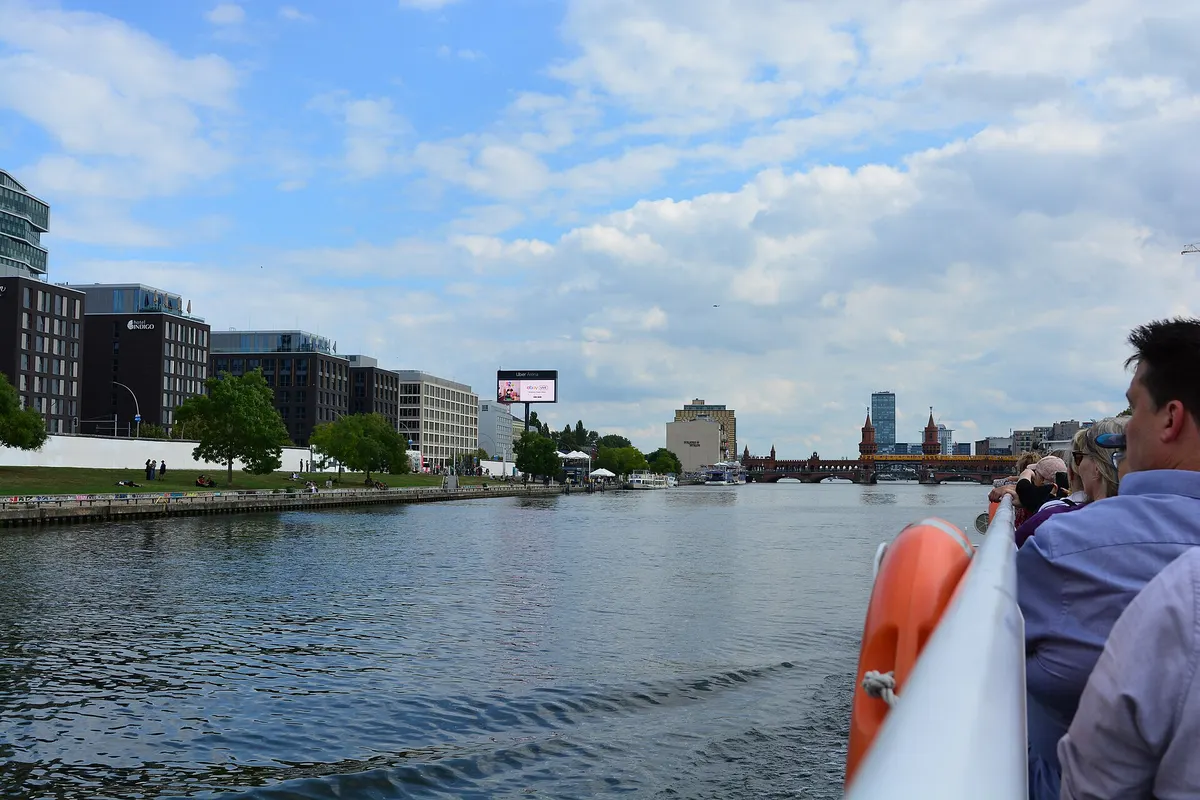
Wikipedia gives the Spree a length of about 400 km. It rises in the Lusatian Highlands in Saxony, with three claimed sources, and joins the Havel at Spandau. The name comes from a Proto-Germanic root meaning to spring forth. Within Berlin the river is part of a dense network of mostly artificial waterways used by commercial traffic and tour boats, and it passes the cathedral, the Reichstag and Museum Island.
A moored boat on a working river
A venue on the Spree sits on a waterway that carries tour boats and freight, yet the comedy boat's page promises no sailing. It is a place to sit, laugh and watch the river rather than travel on it. If you want a trip, book one separately.
The Oberbaum Bridge
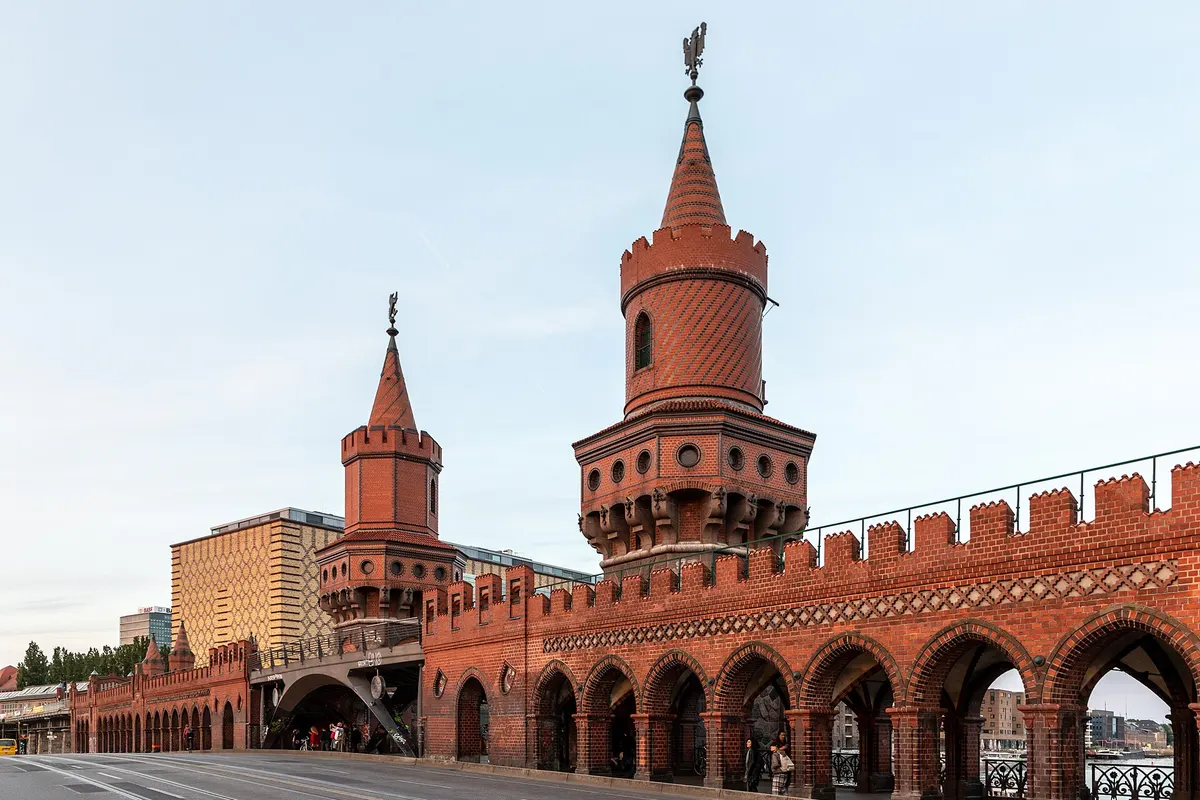
Wikipedia says the bridge opened in 1896 for the Berlin Trades Exhibition, designed by Otto Stahn in North German Brick Gothic, with towers modelled on a gate tower in Prenzlau. It crosses the Spree between Friedrichshain and Kreuzberg, with a road below and U-Bahn lines U1 and U3 above.
War, border and reopening
The article records that the Wehrmacht blew up the bridge's middle section in 1945. After the Wall was built in 1961 the bridge became part of the border between East and West Berlin, a pedestrian crossing for West Berliners in 1963 and a permanent pedestrian opening in 1972. It reopened to traffic and pedestrians on 9 November 1994, with a new steel middle section by Santiago Calatrava.
The neighbourhood
Friedrichshain became part of Greater Berlin in 1920, says Wikipedia, and is known for bars, clubs and cafés around Simon-Dach-Straße and Boxhagener Platz. The East Side Gallery stands on its edge, so an evening on the river fits a neighbourhood used to going out after dark.
Using this on your evening
Walk from Ostbahnhof along the gallery to the bridge before the show, then follow the river. The booking page gives the meeting details, so use this guide only to understand the setting around them.
A bridge that watched a border
The bridge's story is also the city's. It opened in 1896, was damaged in 1945, stood on the border from 1961 and was rebuilt after reunification. Wikipedia adds that since 2001 it no longer crosses a jurisdictional boundary. It also carries a neon installation, Stone - Paper - Scissors by Thorsten Goldberg, installed in 1997, which is easy to miss in daylight.
The river as an address
For an evening, the river is less a route than an address. A venue on the water gives the show a setting that few theatres can match, and it gives the city a reason to hold events on its edge. The page says views of the East Side Gallery are part of the offer, and the Oberbaum Bridge lies at the end of that stretch.
Frequently asked questions
How long is the Spree?
About 400 km, according to Wikipedia.
When did the Oberbaum Bridge open?
In 1896; the rebuilt bridge reopened on 9 November 1994, says Wikipedia.
Does the comedy boat sail?
The booking page promises no sailing.
Sources